Showing posts with label Stock Market. Show all posts

Sunday, October 4, 2009

Can India's economy overtake China?

Can India's economy overtake China?


Workers in a n office
The World Bank says developing economies may drive global recovery

Can the lumbering elephant overtake the hyperactive dragon? What appeared unthinkable for decades, if not for more than half a century, may actually happen soon, perhaps as early as next year.

In 2010, the Indian economy may grow faster than that of China. What is more, experts contend that South Asia could expand at a more rapid pace than East Asia.

While there is no dearth of sceptics who believe that China will continue to grow faster than any other major economy on the globe in the foreseeable future, there are others who contend that the trend growth rates of the two most populous nations could change and that India could march ahead of the Chinese economy just a little faster than many predict.

The economy of India started accelerating from the early 1990s onwards as Delhi loosened bureaucratic controls over industry, trade and services

China and India, accounting for roughly 40% of the 6.5bn plus people on Planet Earth, are not merely the two fastest growing major economies in the world at present, but are among the few countries that have continued to expand at a time when the economies of most countries have contracted.

In the early 1950s, in terms of per capita income and levels of economic development, there was little to distinguish between China and India. Half the populations of both countries were mired in abject poverty - in India's case after centuries of colonial rule.

From the 1970s, the Chinese economy started growing at a fast rate while India's economy grew sluggishly at an average rate of growth of 3.5% - sarcastically described by the late economics professor Raj Krishna as the "Hindu rate of growth".

India consumers
The World Bank predicts India will grow by 8% in 2010

As China grew by double-digits decade after decade for nearly 40 years, economists kept claiming the bubble would burst, that data was doctored by smart statisticians in Beijing - but the metaphorical dragon continued to grow bigger and bigger defying all expectations.

The economy of India, on the other hand, started accelerating from the early 1990s onwards as Delhi loosened bureaucratic controls over industry, trade and services.

In the middle of the 1990s, for the first time since India became independent in August 1947, the country's economy expanded by an annual average of more than 9% four years in succession, that is until the impact of the ongoing international recession saw the Indian economy decelerate.

Economists argue that one reason why India's economy can grow faster than that of China in the near future is simply on account of what statisticians describe as a "base effect".

Following this argument, India's growth rate is higher because the base on which the rate is calculated is narrower.

China's economy is roughly three and a half times bigger than that of India - Gross Domestic Product (GDP) measured in US dollars in 2008 for the two countries stood at $4.2 trillion and $1.2 trillion respectively.

But there is an important reason why India's economy has been hurt relatively less by the ongoing international economic recession in comparison to China, whose growth has been largely export-driven in recent decades.

Exports and imports put together (including "invisible" earnings from tourists, workers' remittances and exports of services) account for approximately half of India's GDP whereas the comparable proportion for China is over 80%.

Forecasts revised

Two years ago, China overtook the US as India's largest trading partner.

In late June, the World Bank in its Global Development Finance 2009 report projected that in 2010, the rate of growth of India's economy at 8% would be faster than that of China, expected to be 7.7%.

The bank's forecast for the current year was revised upwards for both China (from 6.5% to 7.2%) and India (from 4% to 5.1%) but these prognostications are lower than those made by the governments of the respective countries.

The Chinese government claims a rate of growth close to 8% for 2009, while various agencies of the Indian government would place the comparable figure at somewhere between 6.5% and 7%.

Toy seller in front of government slogan, Beijing, July 09
East Asia is predicted to grow at a slower rate than South Asia

The bank report pointed out that the growth rate of all developing countries taken together had come down from 8.1% in 2007 to 5.9% in 2008 and is expected to be only 1.2% this calendar year.

"When China and India are excluded, GDP (gross domestic product) in the remaining developing countries is expected to fall by 1.6%, causing continued job losses and throwing more people into poverty," the World Bank report stated.

Justin Lin, the bank's chief economist, was quoted as saying that developing countries could "become a key driving force" in reviving the world's economy, "assuming their domestic investments rebound with international support, including a resumption in the flow of international credit".

Mr Lin is not alone. Speaking at a recent seminar in Delhi, Ajay Chibber, Assistant Secretary General of the UN's Development Programme, said it would have unthinkable until recently that India could grow faster than China.

"I never thought I would see it during my lifetime but South Asia could grow faster than East Asia," he remarked.

Kalpana Kochhar, deputy director of the Asia Pacific department of the International Monetary Fund, told me that it was no longer improbable that India could grow faster than China or that South Asia would expand at a faster pace than East and South-East Asia.

"I see these as distinct possibilities," she said.

Thursday, September 3, 2009

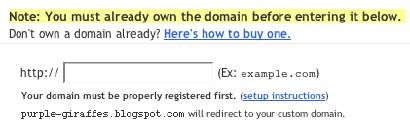
How do I use a custom domain name on my blog?


How do I use a custom domain name on my blog?


Note: The setup process for newly-purchased domains may take up to 24 hours.


Publishing on Blog*Spot is the fastest and easiest way to use all of Blogger's great features. (And for free, no less!) If you don't care to have blogspot.com in your blog's address, though, you can get a domain of your own. We'll continue to host all your content as before, but it will be displayed at your new address. (Unlike FTP publishing, which requires you to buy both a domain name and a hosting service.)


Choose and Register Your Domain


The first thing you'll need to do is to choose a domain name, like example.com and register it. You can register domain names from any of a number of different registrars, and you can use .com, .org, .net or any other valid addresses. Remember: you only need to get the domain name; you don't have to pay extra for hosting service. The easiest way to register a domain is to buy your domain directly through Blogger. If you go this route, we'll automatically configure all of your relevant DNS settings and attach your new domain to your existing blog immediately.


Update the DNS Settings


DNS stands for Domain Name System, and a DNS server determines what site a given address takes you to. So far, you have a domain name but none of the servers on the internet know what to do with it yet. To take care of this, you need to do two things:


  • Create a CNAME record for your blog's address, which should be a subdomain of the form www.example.com.


    To create a CNAME record for your domain with the DNS, associating your domain with ghs.google.com. The exact procedure for doing this varies depending on your domain registrar, but you can find instructions for many common registrars here. If yours isn't listed, or if you run into other difficulties, you can contact your registrar directly and they'll be able to help you out.


  • Create 'A' NAME records for your naked domain (blog.com)


    Creating A records for your naked domain is important as it allows Google to redirect people who use in your naked domain name (blog.com) to your blog page (www.example.com). If you do not do this, visitors who leave off the www will see an error page.


    There are four separate A records you will create, and can be done from the same control panel you accessed your CNAME records. Simply point your naked domain (example.com, without the 'www') to each of the following IP addresses:


216.239.32.21
216.239.34.21
216.239.36.21
216.239.38.21


Your DNS setup is now complete!


Update Your Blogger Settings


Almost done! At this point, you have a domain name, and the DNS servers know to direct people to Google when they want to see your blog. But Google hosts lots of blogs, so we have to make sure the right one is associated with this domain. You'll do this on the Settings Publishing tab for your blog in Blogger.


If you're publishing on Blog*Spot, you'll see a link near the top offering to switch you to a custom domain. Go ahead and click that link.


The Blog*Spot Address setting now changes to Your Domain. Fill in the domain you registered, and then save your settings.


Now the only thing left to do is to tell everybody about your new address!


Notes:


Wednesday, August 26, 2009

How to Beginners Stock Trading: Basic Stock Terminology

How to Beginners Stock Trading: Basic Stock Terminology

Adam W. Porter is a successful investor, and has been trading stocks for over a decade. Adam is the owner of where he offers stock tips and advice through a free newsletter. Learn more about Adam and sign up for his newsletter by visiting http://www.powerfulstocktips.com.

Difficulty: Easy

Instructions

Things You'll Need:

·       In beginners stock trading, knowing the basic terminology is critical. This article covers the most common terms and what they mean.

1.      Step 1

    Stock terminology can get confusing in beginners stock trading. It is not that the terms are misleading, but more because there are so many of them to know. If you take the time to learn a few of these beginners stock trading key words at a time, you’ll be set in no time! Below is a list of the most common terms that you should be familiar with.
    Market / Stock Market / Stock Exchange – An exchange where professional brokers buy and sell stocks. I recommend sticking to the NYSE, Dow Jones, and Nasdaq for beginners stock trading.
    Trading Hours – The time during which stocks can be traded. In the US, trading runs from 9:30am ET to 4:00pm ET.

2.      Step 2

    Market Maker / MM – A firm that conducts the trading of shares between other firms or individuals.
    Ticker Symbol – A unique letter-based symbol used to represent the company’s stock.
    Share – A unit of ownership of a company’s stock.
    Authorized Shares – The total number of shares that a company has.
    Outstanding Shares – Shares that are available to buy or sell in the market.
    Restricted Shares – Shares that cannot be traded for a certain period of time.
    Float – Shares that are available for trade by the investing public.
    Buy – To purchase shares of a company’s stock.
    Sell – To sell shares of a company’s stock.
    Commission – A fee paid to your broker for facilitating a purchase or sale of stock.

3.      Step 3

    Bid – The price at which a broker will buy shares (i.e. a sale of shares would be executed at the Bid price).
    Ask – The price at which a broker will sell shares (i.e. a purchase of shares would be executed at the Ask price).
    Spread – The difference between the Bid and the Ask prices.
    Day Order – An order to buy or sell stock that will be canceled if it does not get filled by the end of the trading day.
    Good Til Canceled / GTC – An order to buy or sell stock that will remain open for 30 to 60 days (varies by broker).
    Limit Order – An order to buy or sell stock that will not go through until the price gets to a specified level, or better.
    Trend – The general direction that a stock is moving…upward or downward.
    Bearish – Describes a stock that is expected to trend downward.
    Bullish – Describes a stock that is expected to trend upward.
    These few terms will give you a good start in http://www.powerfulstocktips.com. It is easier to talk about the stock market if you understand these basic stock terms. Learning them will help in your discussions, your research, and in understanding the helpful tools out there.

Please do not print this email unless it is absolutely necessary.

The information contained in this electronic message and any attachments to this message are intended for the exclusive use of the addressee(s) and may contain proprietary, confidential or privileged information. If you are not the intended recipient, you should not disseminate, distribute or copy this e-mail. Please notify the sender immediately and destroy all copies of this message and any attachments.

WARNING: Computer viruses can be transmitted via email. The recipient should check this email and any attachments for the presence of viruses. The company accepts no liability for any damage caused by any virus transmitted by this email.

www.wipro.com

Stock Information on Auto Manufacturers

Stock Information on Auto Manufacturers

Before buying a stock, investors must analyze the company to make sure that the fundamentals and finances are sound. This is especially true for the auto manufacturers. The auto industry is in a state of turmoil. Several of the manufacturers are restructuring their organizations while others are struggling during the economic decline and reduction in consumer spending. Investors must be sure to analyze an auto manufacturer's stock before making an investment.

    Ford

1.      Ford Motors trades on the New York Stock Exchange using the symbol F. The split adjusted all time low price of Ford's stock was $1.05 in November of 1981. The stock's all time high is $26.21 which it reached in April of 1998. Currently, Ford does not issue a dividend to shareholders.

    General Motors

2.      When General Motors filed for bankruptcy in June of 2009, its stock stopped trading on the New York Stock Exchange. Currently, the assets of General Motors are being controlled by Motors Liquidation which trades over the counter using the symbol MTLQQ.PK.

    Chrysler

3.      Chrysler was purchased by the private equity group Cerberus Capital Management in August of 2007. Chrysler's stock stopped trading when Cerberus bought the majority of the outstanding shares. It is no longer possible for individual investors to buy shares of Chrysler.

    Toyota

4.      Toyota Motor's shares trade on the New York Stock Exchange using the symbol TM. The shares of Toyota reached an all time high of $134.31 in December of 2006. The all time split adjusted low for Toyota's stock was $28.07 in June of 1993. Currently, Toyota pays a quarterly dividend of approximately $0.48 per share.

    Honda

5.      Honda Motors trades on the New York Stock Exchange using the symbol HMC. The all time high for Honda's stock was reached in January of 2007 when it hit $39.33. The split adjusted all time low for Honda was in January of 1991 when it traded at $3.94. Honda currently pays a $0.075 quarterly dividend.

Please do not print this email unless it is absolutely necessary.

The information contained in this electronic message and any attachments to this message are intended for the exclusive use of the addressee(s) and may contain proprietary, confidential or privileged information. If you are not the intended recipient, you should not disseminate, distribute or copy this e-mail. Please notify the sender immediately and destroy all copies of this message and any attachments.

WARNING: Computer viruses can be transmitted via email. The recipient should check this email and any attachments for the presence of viruses. The company accepts no liability for any damage caused by any virus transmitted by this email.

www.wipro.com

Basic Information on the Stock Market in India

Basic Information on the Stock Market in India

Picture (Device Independent Bitmap)

The Indian stock market is made up of 22 stock exchanges. The most prominent among these are the Bombay Stock Exchange, National Stock Exchange, and Over the Counter Stock Exchange of India. According to the Securities and Exchange Board of India (SEBI), the regulatory authority, there were 1,680 registered foreign institutional investors (FIIs) in India as of August 13, 2009. Total investments by FIIs for this period amounted to $65.5 billion.

    The Bombay Stock Exchange

1.      Established in 1875, the Bombay Stock Exchange (BSE) is the oldest stock exchange in Asia. BSE ranks number one globally on the basis of the number of companies listed, which is more than 5,500. As of December 31, 2007, market capitalization was $ 1.79 trillion.
You can buy and sell stocks in the BSE via BSEWEBX.com, an internet trading platform, if you are registered with a BSE broker. The BSE index, the SENSEX, consists of 30 stocks. The exchange has a total of 22 indices,12 of which are sector-based.

    The National Stock Exchange

2.      The National Stock Exchange of India (NSE) is the largest securities exchange in the country on the basis of daily turnover (value). On May 19, 2009, the daily turnover was Rs.8.33 billion. Incorporated in 1992, NSE created an advanced automated electronic trading system, accessible from 1,486 locations in India. NSE commenced operations in the wholesale debt market segment in June 1994. The equities segment was operational in November 1994 and the derivatives segment, in June 2000. The exchange is owned by 20 banks and insurance companies. As of January 8, 2008, the S&P CNX Nifty Index was Rs. 1.32 billion. NSE's subsidiaries are the National Securities Clearing Corporation, NSE Infotech Services and NSE.IT (securities technology).
NYSE Euronext, a division of the New York Stock Exchange, has a 5 percent equity stake in NSE.

    Over the Counter Exchange

3.      Established in 1990, Over the Counter Exchange of India (OTCEI) is the only exchange in the country that permits small and mid-sized companies, operational for less than three years, to raise funds in the capital market. It was the first exchange in India to permit market making---a two-way buy/sell order for securities.

    SENSEX Components

4.      The BSE Sensex consists of 30 large-cap companies in a smattering of industries including cement, telecommunications, real estate, banking, IT, construction, automobile, oil, pharmaceuticals, energy and steel. Major companies in the Sensex are Infosys Technologies (also listed in NASDAQ), Reliance, Tata Steel, Tata Power, and Tata Motors, which owns the Jaguar, Land Rover and Range Rover brands.

    NSE 50 Components

5.      The S&P CNX Nifty consists of 50 companies in 21 industries such as cement, telecommunications, pharmaceuticals, banking, automobile, construction, aluminium, oil exploration, gas and finance. Prominent companies are Bharat Heavy Electricals,Bharti Airtel, Cairn India, GAIL (India), Hero Honda Motors, Hindustan Unilever, Housing Development Finance Corporation and Infosys Technologies.

Please do not print this email unless it is absolutely necessary.

The information contained in this electronic message and any attachments to this message are intended for the exclusive use of the addressee(s) and may contain proprietary, confidential or privileged information. If you are not the intended recipient, you should not disseminate, distribute or copy this e-mail. Please notify the sender immediately and destroy all copies of this message and any attachments.

WARNING: Computer viruses can be transmitted via email. The recipient should check this email and any attachments for the presence of viruses. The company accepts no liability for any damage caused by any virus transmitted by this email.

www.wipro.com

What to Do With Stock When the Market Falls

What to Do With Stock When the Market Falls

Picture (Device Independent Bitmap)

It's important to have a plan for the inevitable stock market declines.

No stock or market goes up forever in a straight line -- and if it does, it probably means it's about to come crashing back down. Stock markets inevitably fall for a variety of reasons. As an investor, it's important to have a plan in place before it happens. Those who can foresee a fall can actually profit on the drop, or at least offset losses, with a simple options strategy. Otherwise, the best choice might be to take advantage of lower prices with new purchases, or simply take the loss and write it off on your taxes.

    Sell Calls

1.      If you're fortunate enough to identify a downtrend in the market just before it happens or early in the decline, one of the best ways to protect your investment is to sell calls. A covered call is the safest and simplest option strategy there is because it only involves selling calls against stock you own. Each 100 shares is equivalent to one options contract. Any call you sell will net you an immediate credit for the proceeds of the sale, and if the call expires worthless, you keep that money. If the call gets exercised, you keep the proceeds of the original option sale, plus the proceeds of your stock, which is sold at the strike price of the call options. The worst-case scenario is that the stock declines more than the proceeds you collect for the options sale, but even so, you're better off than if you hadn't sold the calls. The more accurately you can predict the duration and depth of the decline, the better able you will be at maximizing the proceeds of the option sale by picking the optimum series and strike price. Another benefit of this approach is that you can continue to collect dividends on the stock you own despite having sold calls against it.

    Buy More

2.      If you aren't fortunate enough to have foreseen a decline in the stock market, you can still take advantage of the lower prices by purchasing more shares. This approach requires caution and due diligence, however. While it's believed that stock indexes eventually revert to their long-term averages (a theory called mean reversion), a steep decline in an individual stock can signal a serious change in the company's condition that could prevent a return to higher prices. It's also risky to buy all at once without knowing if the decline has ended. If a company appears to be intact and likely to return to its typically higher prices, it's a good idea to make incremental purchases with the new cash you've allocated to the name. One approach, called dollar-cost averaging, involves buying an equal dollar value of shares over a certain period of time, with more shares being purchased if the price is low and less if it is higher. Another way is to simply decide on a number of shares and buy equal lots of shares until the predetermined quantity is reached. As with covered calls, you continue to collect dividends on stock (assuming the company continues to pay them) and actually capture a higher yield by purchasing at lower prices.

    Take Losses

3.      No one likes to lose money, but one good thing capital losses are good for is offsetting capital gains. If you happen to have significant capital gains in a particular tax period, you might elect to take a loss on stock that has fallen to lower your tax liability. If you choose to do so, however, be sure to consider the IRS wash rule, which could prevent deducting capital losses if they were incurred 30 days before or after the acquisition of substantially identical stock. In other words, you can't take a tax loss on stock that you've held for less than 30 days, and you can't reinvest the proceeds of the sale into the same stock for 30 days after the sale or the loss will be disallowed for tax purposes. Also be aware that if your capital losses exceed your capital gains, you can only deduct the excess up to $3,000 in a single year (the rest can be carried over to future years).

Please do not print this email unless it is absolutely necessary.

The information contained in this electronic message and any attachments to this message are intended for the exclusive use of the addressee(s) and may contain proprietary, confidential or privileged information. If you are not the intended recipient, you should not disseminate, distribute or copy this e-mail. Please notify the sender immediately and destroy all copies of this message and any attachments.

WARNING: Computer viruses can be transmitted via email. The recipient should check this email and any attachments for the presence of viruses. The company accepts no liability for any damage caused by any virus transmitted by this email.

www.wipro.com

Successful Stock Trading Tools

Successful Stock Trading Tools

In the past, you needed to use a broker to buy stocks or bonds. Now you can now use online stock-trading tools to execute trades of all kinds, including many of the more complicated transactions such as options and futures trading.

    Trading Platforms

1.      Trading platforms have advanced rapidly over the past few years. Companies such as E-Trade and Scottrade offer the latest stock trading tools to help you make decisions based on past performance and estimated future performance of stocks. These websites are easy to use. Navigation is simple and straightforward. Virtual charts and watch lists for underperforming stocks allow you to buy stocks for less than they may be worth in the future. Calculators of all kinds allow you to see how much you will profit from price movements, and automated trading takes the difficulty of trading away.

Most online brokerage houses also have tools such as alerts, videos and blogs to help you decide which sectors to invest in as well as highlight particular stocks have performed well in the past. You can pick tools based on your familiarity with the stock market, as many of the brokerage houses are aimed at beginners to the investing world. Several others, such as Zecco and Think or Swim, are geared to advanced traders and offer tools for more advanced trading such as options and derivatives, which are based on more complicated calculations. There is no way to predict what stocks will do, but these tools may help you become a successful investor.

    Trading Robots

2.      Install a trading robot on your computer. Originally developed for the foreign exchange market, these robots take the emotional element out of stock trading. By setting parameters in which the robot will follow, you have no emotional response to what is being bought and sold. Although the stock market fluctuates based on human perceptions, the trading robot removes this element and focuses on pure profits and losses.

    Charts and Indicators

3.      Visit websites such as Yahoo! Finance and Bloomberg.com to take a look at financial reports from companies you are interested in. With real-time charts of stock performance and new reports about the individual firms, you can gather crucial information about the financial performance of these firms to pick and choose the stocks that will perform well in the future. These websites also have tools that will show you overall past performance and anticipated future performance based on assumptions and trends.

Please do not print this email unless it is absolutely necessary.

The information contained in this electronic message and any attachments to this message are intended for the exclusive use of the addressee(s) and may contain proprietary, confidential or privileged information. If you are not the intended recipient, you should not disseminate, distribute or copy this e-mail. Please notify the sender immediately and destroy all copies of this message and any attachments.

WARNING: Computer viruses can be transmitted via email. The recipient should check this email and any attachments for the presence of viruses. The company accepts no liability for any damage caused by any virus transmitted by this email.

www.wipro.com

How to Use Excel Add Ins for Stock Quotes

How to Use Excel Add Ins for Stock Quotes

Picture (Device Independent Bitmap)

excel add ins

You can use free Excel Add Ins for applications such as obtaining updated stock quotes. Use the steps below to save all the stock symbols you’re interested into a spreadsheet using an excel add in. You will then have a spreadsheet that you can use for tracking your investments with refreshable stock quotes from MSN Money.

Difficulty: Easy

Instructions

1.      Step 1

    In order to use this Excel add in, make sure that you have Excel installed on the computer you are using.

2.      Step 2

    Go to www.microsoft.com/downloads/ to get the MSN Money Stock Quotes Excel Add In. Look at the resources section towards the bottom of this web page for a link to the add-in download.

3.      Step 3

    Pick your connection speed next to the “Estimated Download Time” and then click on download to install the Excel add-in onto your computer.

4.      Step 4

    Once you have downloaded the excel add-in for stock quotes, open up a new Excel worksheet. Click on a cell where you would like to start adding stock quotes. Now click on Add-Ins (on the toolbar at the top of the page). Pick “Insert Stock Quotes”.

5.      Step 5

    When the “Insert Stock Quotes” gui pops up, type in the symbol for the stock you’re interested in. In the properties section click on the different variables that you’re interested in and then click on “Add”. Click on “Ok” at the bottom of the pop up window. You should now see the updated stock quote information for the stock you picked.

6.      Step 6

    To add another stock to your spreadsheet, click on a cell in the next row and follow the same process until you have a list of all the stocks that you want to keep up with. Save out the spreadsheet onto your computer.

7.      Step 7

    To view updated stock information, open up your saved spreadsheet. Click on Add-Ins and “Update Quotes” to update your stock quote information.

Please do not print this email unless it is absolutely necessary.

The information contained in this electronic message and any attachments to this message are intended for the exclusive use of the addressee(s) and may contain proprietary, confidential or privileged information. If you are not the intended recipient, you should not disseminate, distribute or copy this e-mail. Please notify the sender immediately and destroy all copies of this message and any attachments.

WARNING: Computer viruses can be transmitted via email. The recipient should check this email and any attachments for the presence of viruses. The company accepts no liability for any damage caused by any virus transmitted by this email.

www.wipro.com

Daily Stock Market Tips

Daily Stock Market Tips

The stock market changes by the minute. In an instant, stock prices can skyrocket or plummet. This is why it's important to be an informed investor, involved with your stocks on a daily basis. You don't have to be obsessive about checking your stock's prices, or spend hours a day doing research, but steps can be taken to boost your success.

    Keep Strategy in Mind

1.      With every daily decision you make regarding stock market investing, you should keep your overall investment strategy in mind. For example, are you investing for the long term in order to protect and pad your nest egg? Or are you looking to make some big gains in the short term? No matter what your goals or strategy, it's important to stick with your program--the most successful traders have a consistent strategy, rather than jumping around from strategy to strategy. Warren Buffett, for example, sticks to a value-oriented strategy that involves only purchasing stock that is selling for less than what it is actually worth.

    Know When To Sell

2.      On a daily basis, your stocks will fluctuate. Don't be discouraged by a small decrease in the price of your stock, and don't sell your stock based on a set of rules you apply to every stock. For example, "I'll sell my stock when it has increased in value by XX%" This could prevent you from cashing in on even bigger growth. On the other hand, waiting for a stock to rebound from a long decline could hurt your portfolio in the long run. Evaluate each stock on a case-by-case basis, looking at the variables that are causing the price to rise and fall and the general future business plans of the company before you decide to sell or stick with a stock.

    Stay Up on Business News

3.      Reading news about companies you own stock in, or companies you are considering investing in, and the industries they are in on a daily basis is crucial. Also keeping abreast of more general news about the economy is important. In order to be a successful investor, you have to be aware of the events that could potentially affect the price of your stock in an instant. Set up a news alert feed via Google Alerts with keywords relating to your company and its industry to stay on top of important developments.

Please do not print this email unless it is absolutely necessary.

The information contained in this electronic message and any attachments to this message are intended for the exclusive use of the addressee(s) and may contain proprietary, confidential or privileged information. If you are not the intended recipient, you should not disseminate, distribute or copy this e-mail. Please notify the sender immediately and destroy all copies of this message and any attachments.

WARNING: Computer viruses can be transmitted via email. The recipient should check this email and any attachments for the presence of viruses. The company accepts no liability for any damage caused by any virus transmitted by this email.

www.wipro.com

Suggestions for Buy-Low-Sell-High Stocks

Suggestions for Buy-Low-Sell-High Stocks

"Buy low, sell high" is the ultimate stock trader's mantra. It's the best way to make quick money in the stock market. However, it is easier said than done. At times, those that invest in the stock market purchase at the wrong time, and in fact find themselves buying high and then having to sell low. Don't get caught in the stock market hype, and use your resources carefully to be successful in the stock market.

    Know the History

1.      When deciding whether to buy or sell a certain stock, take a moment to examine that stock's particular history. Sites like eTrade.com and ScotTrade.com can give you a recent history of a stock's activity. Watch out for stocks that have a long history of instability, where their history looks like a roller coaster. Although there is money to be made with these stocks, you have to be able to take a big risk with them and even be prepared to lose some money if they drop unexpectedly. Leave these stocks to the pros.

    Watch the Market

2.      Changes in the market often come when a very public change is made to the company, or the company has been in the news. Once a newscast reports that a company has reported large earnings, many people rush to get in on the action and buy stock with them. However, this is the absolute wrong time to buy. The stock is on its way up, and you might end up paying a premium price for a stock that will drop once it's out of the limelight. Keep your ear to the market and try to pick up on rumblings before they are reported. The best time to get in on a popular stock is before anything is announced.

    Steady Stocks

3.      In the stock market, slow and steady often wins the race. Look for stocks that steadily and slowly rise. These are the ones that often fly under the radar, but are still good moneymakers. Also, watch the market for stocks that were initially some of the highest, and for whatever reason dropped. This might be the best time to buy low, because if it is a reliable company who experienced a changing of the guard or a layoff, their stock prices will temporarily and quickly dip, before climbing back up to where they were previously.

    Be Patient

4.      When trying to buy low and sell high in the stock market, you'll need to master the art of patience. While you may hear stories of traders making a million in one day, this is not realistic for you. Place your money in a stock of your choice, and then watch the market carefully. Set an amount for yourself that you'd be happy to get, and sell when you get to the point where you make a suitable return. Many traders have ended in ruin when they let their excitement and greed get the best of them. Be realistic and patient, and expect losses to be a truly great trader.

Please do not print this email unless it is absolutely necessary.

The information contained in this electronic message and any attachments to this message are intended for the exclusive use of the addressee(s) and may contain proprietary, confidential or privileged information. If you are not the intended recipient, you should not disseminate, distribute or copy this e-mail. Please notify the sender immediately and destroy all copies of this message and any attachments.

WARNING: Computer viruses can be transmitted via email. The recipient should check this email and any attachments for the presence of viruses. The company accepts no liability for any damage caused by any virus transmitted by this email.

www.wipro.com

How to Buy Stocks in a Bear Market

How to Buy Stocks in a Bear Market

Picture (Device Independent Bitmap)

Should you buy or should you sell?

While everyone is running to sell of their iffy stocks and the market is fluctuating faster than a Monarch butterfly's wings, it just might be the time to make some cautious purchases. But what do you need to know if you're going to take the plunge?

Difficulty: Moderate

Instructions

1.      Step 1

    Buy what you know and like. This is a great rule of thumb for purchasing stocks in a bear market. Chances are, if you like the company and the product, others will too, leading to a increase in value when the market turns.

2.      Step 2

    Research your top picks online for customer satisfaction ratings. If you are stuck with a cellphone company that overcharges and has bad customer service, see what others are saying. If there are lots of complaints - pass that one up.

3.      Step 3

    Look to the future. What's hot and what's on the horizon? Listen to your local business news. Pay attention to the Science and Health headlines. If everyone's worried about global warming, look for solid alternative energy stocks to invest your money.

4.      Step 4

    Diversify. You don't have to buy a mutual fund to take advantage of diversification. Trust your own judgment. Your opinion and your observations are as good as the next guy's.

5.      Step 5

    Take advantage of lower stock prices in a bear market but don't just run out and buy the cheapest ones. Do your homework first and don't let cost be your only deciding factor.

Please do not print this email unless it is absolutely necessary.

The information contained in this electronic message and any attachments to this message are intended for the exclusive use of the addressee(s) and may contain proprietary, confidential or privileged information. If you are not the intended recipient, you should not disseminate, distribute or copy this e-mail. Please notify the sender immediately and destroy all copies of this message and any attachments.

WARNING: Computer viruses can be transmitted via email. The recipient should check this email and any attachments for the presence of viruses. The company accepts no liability for any damage caused by any virus transmitted by this email.

www.wipro.com

How to buy Stocks in todays Markets

How to buy Stocks in todays Markets

Picture (Device Independent Bitmap)

The ride is bumpy, but stocks are cheap

Investing in the stock market was never easier, nor cheaper than it is right now. And its a proven fact that over time, stocks make money. Is it gambling? Some people think so. I like the term investing for the future better. There are a lot of ways to invest with out the money coming directly out of your pocket.
Just make sure you do a little research before jumping in to any investment.

Difficulty: Moderately Challenging

Instructions

Things You'll Need:

·       Either a job which offers retirement benefits, or a few dollars in the bank(currently paying little to no interest)

·       A time frame of 3-5 years before you REALLY need these invested dollars

·       Being able to stomach a roller coaster ride.

1.      Step 1

    Picture (Device Independent Bitmap)

    How dividends compound

    Is there a certain company that you like to own a part of, maybe the company that you work for (hopefully a strong stable company)? Or how about a favorite store, or a product out there? The great thing in this country is that we have the ability to own stocks in our favorite companys. Hopefully the company you like, pays a good dividend. This is like them paying you interest on the money you invested. Individual stocks can be risky, as their share price can fluctuate alot. So in todays markets, it can be a roller coaster ride owning stocks.

2.      Step 2

    Picture (Device Independent Bitmap)

    Invest in a group of stocks for more diversification

    Maybe there is a whole segment of the market that you would like to invest in (solar energy, wind power, utilities, energy, etc.). If this is the case, a mutual fund, or ETF would be the way to go. They invest in a group of stocks in a certain segment of the market. Therefore, you have ownership in numerous companies. Although somewhat risky, their prices usually do not fluctuate as much as an individual stock. You can buy mutual funds directly through some fund companies (called no load funds) or go through your broker (and pay a sales load)
    My advice is to do your own research, and avoid paying sales loads. They eat up alot of your profits.

3.      Step 3

    Picture (Device Independent Bitmap)

    There is alot of education available

    ETF Funds, better known as Electronically traded funds are bought and sold like stocks. There is a lot of research out there, but I like these a little better than mutual funds.The reason is that I can sell them more quickly than I can sell a mutual fund. These funds are made up of a group of stocks in the same industry. For example my energy ETF I own
    (the ticker is XLE) owns stocks such as Exxon, Chevron Corp, ConocoPhillips,Schlumberger Ltd, Occidental Petroleum. Therefore, I have ownership in all these companies. But I only pay one price to buy the ticker XLE. It trades as though it were a stock.

4.      Step 4

    Picture (Device Independent Bitmap)

    Reinvest the dividends into more stock ownership

    Try to invest in companies that have dividend reinvestment options. This means that when the company pays a dividend, the proceeds buy more shares of the stock, rather than putting the money in the bank for you.
    (The tax consequences are more to your advantage) Not all brokerage firms offer this option. I do most of my trading through Scottrade, which has GREAT research abilities, but does not offer dividend reinvesting. (Trades are $7.00) So I recently opened another account with SOGO Trade ($1.50- $3.00 a trade) which does have a dividend reinvestment program. Do your research before investing. I will be glad to answer any questions you have.

5.      Step 5

    Picture (Device Independent Bitmap)

    Hang on, its only a ride!

    Investing can be very scary, or very fun and challenging. My husband and I have retired at 55 and 53 years old, because we made alot of good investments. (Some were in real estate properties which we still own)But the point is, if you don't save for the future, you will work hard all of your life. A saying I will always remember is, pay yourself before you pay everyone else. Even if it is a small amount. A penny saved, IS a penny earned! Don't be embarrassed to pick up a penny off the ground. It could be the foundation to a fortune! I hope someone can benefit from these tips.

Please do not print this email unless it is absolutely necessary.

The information contained in this electronic message and any attachments to this message are intended for the exclusive use of the addressee(s) and may contain proprietary, confidential or privileged information. If you are not the intended recipient, you should not disseminate, distribute or copy this e-mail. Please notify the sender immediately and destroy all copies of this message and any attachments.

WARNING: Computer viruses can be transmitted via email. The recipient should check this email and any attachments for the presence of viruses. The company accepts no liability for any damage caused by any virus transmitted by this email.

www.wipro.com

How to Buy Stocks That Will Make Money

How to Buy Stocks That Will Make Money

Picture (Device Independent Bitmap)

We live in a world today where there are many opportunites to make money. However, sometimes it seems that the rich get richer, and the poor get poorer. Here are some tips on how to make some sound financial moves and make money.

Difficulty: Challenging

Instructions

Things You'll Need:

·       internet access

·       time

1.      Step 1

    Whenever buying stock, the most simple idea is to buy when stock is down, and sell when up. It seems like an easy concept, but it is not that easy. Sometimes stocks rise and fall, and there is no way to truly predict what the outcome will be on a day to day basis. For this reason, you have to realize that day-trading is for the pro's.

2.      Step 2

    Whenever you buy a stock, you must be willing to hold the stock for an extended period of time, sometimes even years. When a stock gets low, you have to have the patience to hold the stock, or even buy more, so when the value goes back up, you make bunches of money. If you are not a day-trader, why sell a stock for a loss? The only way you should lose money on a stock is if the company you invested in goes bankrupt.

3.      Step 3

    Now the question is, what company's stock do I buy? Try and look at websites that show the value of the stock, 52 week lows and highs, and press releases. This information can give you a pretty good idea on whether or not you are making a sound financial investment. Also, listen to the analysts you see on TV. Chances are they have information that we do not have access to and can help persuade us against a bad decision, or help us make a good decision we are worried about.

Please do not print this email unless it is absolutely necessary.

The information contained in this electronic message and any attachments to this message are intended for the exclusive use of the addressee(s) and may contain proprietary, confidential or privileged information. If you are not the intended recipient, you should not disseminate, distribute or copy this e-mail. Please notify the sender immediately and destroy all copies of this message and any attachments.

WARNING: Computer viruses can be transmitted via email. The recipient should check this email and any attachments for the presence of viruses. The company accepts no liability for any damage caused by any virus transmitted by this email.

www.wipro.com

How to Determine When to Buy Stocks

How to Determine When to Buy Stocks

Knowing when to buy stocks can be a challenging task. Following a few simple steps can make the process easier.

·       Picture (Device Independent Bitmap)

Difficulty: Easy

Instructions

1.      Step 1

    Determine what your goals are: How much do you wnat to invest? What type of return do you hope to get? How long do you want your money invested in stocks?

2.      Step 2

    Research the industry, the companies and the products you are interested in. Trade magazies, newspapers and industry and company websites are particularly useful. In addition, Internet-based news services can provide you with up-to-the-minute information on teh companies and industries of your choosing.

3.      Step 3

    Talk with a broker if you have one. Tell them what you are interested in and ask them to do the research for you.

4.      Step 4

    In determining when to buy, it is important to ask questions such as the following: Is the industry prospering or declining? If it is prospering, how much higher will it go? If it is declining, how much farther will it fall? Will it rebound? Is this company profitable? What are it's products? Will these products continue to be big sellers or are new products on the way? When will this happen?

Please do not print this email unless it is absolutely necessary.

The information contained in this electronic message and any attachments to this message are intended for the exclusive use of the addressee(s) and may contain proprietary, confidential or privileged information. If you are not the intended recipient, you should not disseminate, distribute or copy this e-mail. Please notify the sender immediately and destroy all copies of this message and any attachments.

WARNING: Computer viruses can be transmitted via email. The recipient should check this email and any attachments for the presence of viruses. The company accepts no liability for any damage caused by any virus transmitted by this email.

www.wipro.com

How to Buy and Sell Stocks

How to Buy and Sell Stocks

Stocks are a lot like sex in high school: Everyone pretends to know everything, few actually know anything, and nobody ever lets on about what they don't know. Here's what to look for, and how to build a stock portfolio that's right for you.

·       Picture (Device Independent Bitmap)

Difficulty: Moderately Challenging

Instructions

Things You'll Need:

·       Fidelity's Comparison Table

1.      Step 1

    Understand how stocks operate. Stocks are a form of equity investing, because when you buy shares of stock you actually get partial ownership of that company. When a company does well, its value increases, and so does the value of the shares.

2.      Step 2

    Join the National Association of Investors Corporation (NAIC) to gain access to a low-cost stock purchase program. Members can buy stock in a long list of companies, paying as little as $10 a month, as a way to slowly build a nest egg. The cost to join NAIC is less than $50 a year and includes a monthly subscription to a magazine on investing.

3.      Step 3

    Get to know the stock exchanges. Stocks are traded on three major exchanges in the United States: the New York Stock Exchange, which includes some of the biggest companies in the world; the American Stock Exchange; and the NASDAQ National Market System, an electronic exchange. Each exchange trades the stocks of different companies, so once you choose a company to invest in, find out which exchange it is traded on in order to monitor it.

4.      Step 4

    Familiarize yourself with different types of stocks. Growth stocks are stocks in relatively inexpensive companies that have a good chance to increase in value. Income stocks have less growth potential but consistently produce high dividends. Other types include value stocks, which are a variant of growth stocks; cyclical stocks, which are tied to economic ups and downs; and international stocks, which are stocks in foreign companies that may or may not be traded on U.S. exchanges.

5.      Step 5

    Clarify your investment goals. Do you need to stockpile funds for your retirement or are you looking to purchase a house within two years? Or are you looking for investments that produce income? As a general rule, the longer the investment time frame, the more aggressive you can afford to be.

6.      Step 6

    Determine how stocks fit into your overall portfolio. Stocks, like all investments, should take up a limited portion of your assets according to your master financial plan. Construct an asset allocation for your entire investment portfolio, decide how much of it should go to stocks, and stick to that percentage. As stocks gain and lose value, you may need to buy or sell to maintain your planned mix.

7.      Step 7

    Start with simple parameters. Pick companies that you know and products that you're familiar with. Do you use them? Are they good?

8.      Step 8

    Understand the underlying fundamentals of the companies whose stock you buy. These include the markets they are in, their balance sheet (which shows assets and liabilities) and their competitors. Another indicator is the company's past and present earnings and how that relates to the number of shares the company has outstanding (known as earnings per share). This is a closely watched number among professional investors.

9.      Step 9

    Review stock analyses from research firms like ValueLine and Morningstar, which sell subscriptions to their reports. Local libraries typically carry recent issues.

10.     Step 10

    Calculate the stock's price-earnings (P/E) ratio. This ratio divides the price per share of the stock by its earnings per share. This shows you how expensive a stock price is when compared with the company's actual earnings. As a rule, the higher the P/E, the more the potential of the company may already be priced into the stock.

11.     Step 11

    Get professional help. The most traditional avenue is through a brokerage house, where you can get firsthand advice from a broker. But you'll pay a commission for any transaction (which, depending on the house, can be substantial). See How to Choose a Stockbroker.

12.     Step 12

    Look at online brokerages and discount houses. The commissions are low, the trades are quick, and the research resources are often extensive, but you won't get any hand-holding.

13.     Step 13

    Match your stock to your needs and temperament: Invest in risky stocks only if you have the stomach and the time to ride out market fluctuations.

14.     Step 14

    Diversify for greater safety. When buying several stocks, mix things up. Buy stocks from different industries, and balance aggressive stocks with more conservative choices.

Please do not print this email unless it is absolutely necessary.

The information contained in this electronic message and any attachments to this message are intended for the exclusive use of the addressee(s) and may contain proprietary, confidential or privileged information. If you are not the intended recipient, you should not disseminate, distribute or copy this e-mail. Please notify the sender immediately and destroy all copies of this message and any attachments.

WARNING: Computer viruses can be transmitted via email. The recipient should check this email and any attachments for the presence of viruses. The company accepts no liability for any damage caused by any virus transmitted by this email.

www.wipro.com

Popular Posts